This is something I've wanted to write about for a while, but never got around to. But this morning Greg and I were having a conversation about the sci-fi and fantasy genres, and I remarked that the lack of female characters in the genre makes it less welcoming to women. And Greg ... doesn't see that. I have a hard time articulating this sort of thing, but I'm going to give it a try.
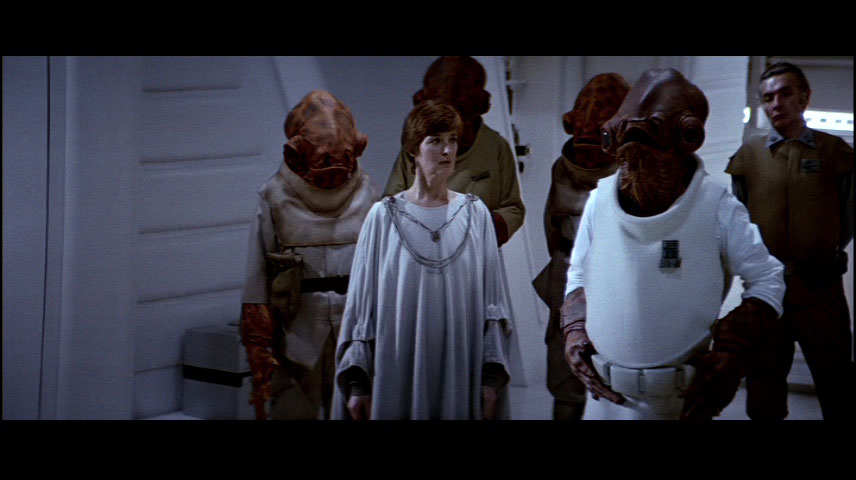
I was telling him about James dictating a Star Wars game for himself, me, Evan, Neighbor Girl and Neighbor Girl's mother. James was Anakin Skywalker, Evan was Luke Skywalker, Neighbor Girl was Princess Leia, Neighbor Girl's mother was Padme Amidala, and I was Shmi. (Do you know who that is? Anakin's mother.) I realized as he was assigning parts that he'd gone through almost every female Star Wars character I know. (I can think of one other -- Mon Mothma -- but if you haven't spent hours reading through Star Wars books with your obsessive sons, you probably don't know who she is, because she doesn't play a very important role and is never mentioned by name as far as I know.)
I'm talking strictly movies here -- which is what the general population is familiar with -- even though I'm vaguely aware that Star Wars books and games introduce a lot of other female characters. The movies have, essentially, three important female characters (and calling Shmi important is kind of a stretch). For Neighbor Girl to play a cool Star Wars woman, she can be Leia or Padme. But my boys? They can be Luke, Anakin, Han Solo, Chewbacca, Obi Wan, Darth Vader, the Emperor, Mace Windu, Yoda, Qui-Gon Jinn, Boba Fett, Lando... and that's just off the top of my head.
The same goes for Lord of the Rings, the other big fantasy series of recent years. Obviously you can find fantasy with female lead characters if you're looking for it (Philip Pullman's His Dark Materials trilogy comes to mind) but the works in that genre -- both in movies and books -- which become popular in the larger culture, which trancsend the genre to become universally well-known, are dominated by male characters.
Greg (along with a lot of other people) doesn't think that's a big deal. He pointed out the important role Eowyn played in Lord of the Rings as an example -- but she's still a bit player who just happens to perform a crucial role. And she's one of three notable women in the entire series. And the thing that it's hard to get across to a man, who has grown up watching men dominate society, in both the real world and fiction, is that this disparity matters. The numbers matter. The stereotypes matter. The lack of representation matters. It matters to see a world not populated by people like you. If little girls can't find role models in a genre, it will not appeal to them as much as a genre that does have those role models.
I could probably go on and on about this (and I probably will return to this topic again), but luckily for you I've got other demands on my time. But I do have one item to leave you with before I wrap up this post. Actress Geena Davis has founded an organization called See Jane, which aims to promote the need for equal gender representation in kids' entertainment. You can watch Geena give a phenomenal speech here (sorry, couldn't get the embedding to work), or if you don't have 20 minutes to watch the video (though I'd really recommend that you do, if you have the time), you can read a short article at Ms. Magazine about her ogranization. Their research came up with some surprising statistics about gender distribution in kids' media, and I think you'll find, if you start keeping count, the same imbalance often holds true for adult entertainment as well (unless you're watching something specifically designated as a chick flick or something similar).
As Davis says in the Ms. article, “If your movie gets labeled a chick flick it’s the kiss of death. What if that has something to do with having seen the exact same gender disparity from minute one, from the very first cartoons and programs you see — couldn’t that possibly affect the way we grow up feeling?” I'd go a step further and say, how can it possibly not affect the way our culture views gender? How can it not affect the way little girls see themselves, or the way boys see girls, to see boys at the center of every story, and girls in the supporting roles? The message sinks in so gradually and so insidiouly that most people don't realize it, and eventually don't even think it matters that much.
Read More...
Summary only...